

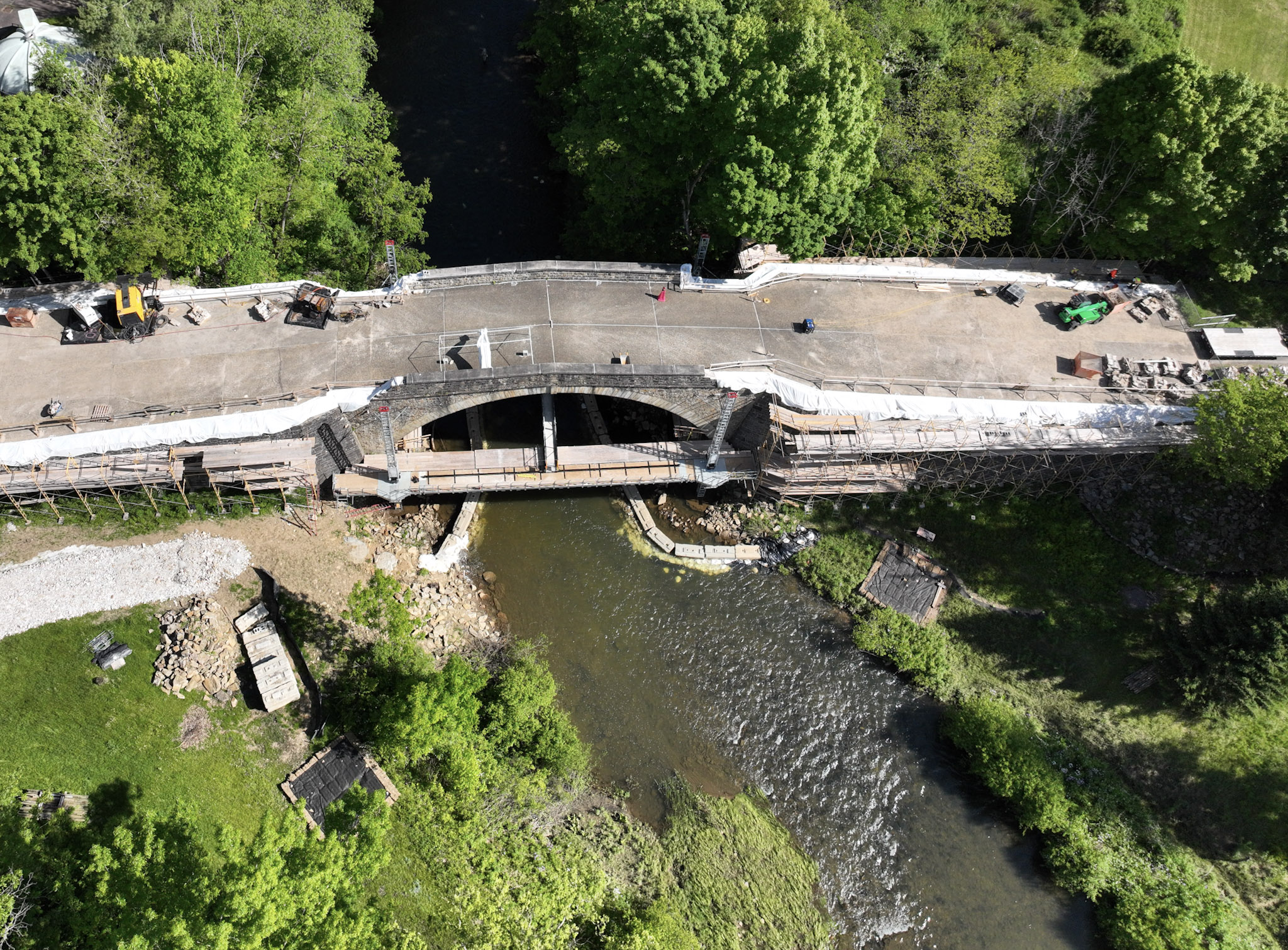
 Casselman River Bridge State Park in Garrett County recently joined the National Park Service’s Underground Railroad Network to Freedom, which honors and preserves the history of resistance to enslavement.
The landmark earned the designation thanks to its role in the emancipation of author, minister and abolitionist Josiah Henson.
When Henson crossed the bridge in 1828, it was about 15 years old, and at the time, the largest stone arch bridge in the fledgling nation. The Maryland Department of Natural Resources and Maryland Department of Transportation are now stabilizing and resurfacing the bridge to ensure another two centuries as a National Historic Landmark.
Bridge Opens in 1813
The area where the Casselman River Bridge was built carries the history of many crossings, including thousands of years of use by Indigenous Peoples. In 1755, General Edward Braddock and a young George Washington forded the river there during an ill-fated expedition to Fort Duquesne. Washington named the area Little Crossings.
Soon after, an inn was built near the ford. Little Crossings became a big thoroughfare for people headed west.
When construction of the National Road began in the 19th century, following the Cumberland Road, planners sought a contractor to construct an 80-foot span over the Casselman River at Little Crossings.
The chosen design relies on carefully placed stones, hewn from nearby quarries, the combined weight of which keeps the structure whole. Contractor David Shriver staked his reputation on the project – he stood beneath the structure the night before it was officially unveiled, pulling a key support – if the bridge collapsed, he would be ruined. But it didn’t collapse.
It has stood for 213 years – trampled by hooves and ridden over by wagon wheels and, eventually, rubber tires.
Freedom Seekers on the National Road
In 1828, Josiah Henson crossed the bridge while on his way from Kentucky to Montgomery County, during an ultimately fruitless effort to purchase his freedom.
According to Maryland Park Service Historian Robert Bailey III, because Henson traveled the National Road with permission, and had no need for secrecy, it can be assumed that he crossed the bridge while travelling between Wheeling and Cumberland.
Henson arrived in Montgomery County expecting to purchase his freedom for $100, but his enslaver added a zero to that sum. Henson learned his enslaver was planning to sell him to a plantation in Louisiana, separating him from his wife Nancy. The couple self-emancipated, travelling to Canada by way of Indiana and Ohio.
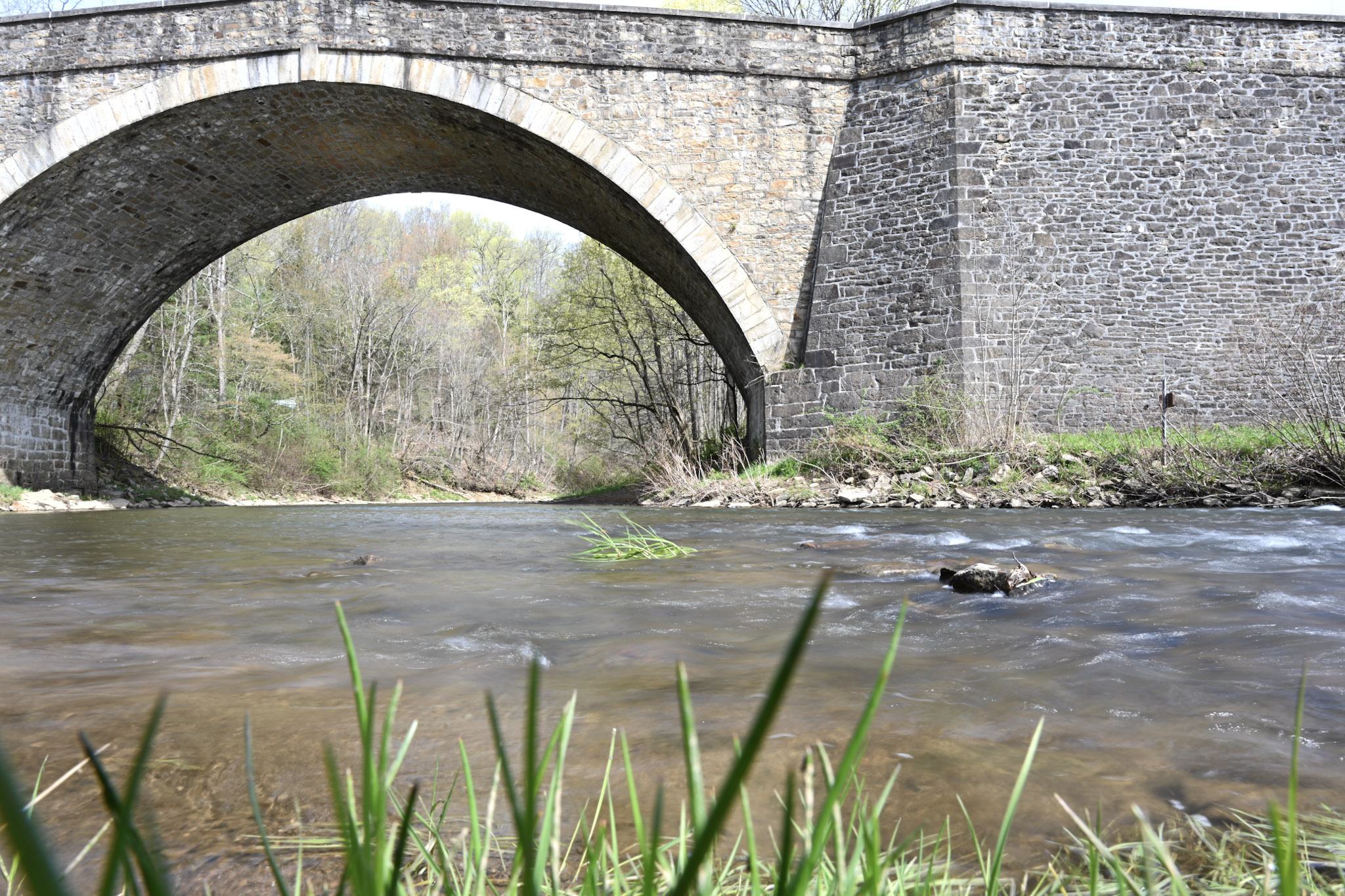
The Casselman River Bridge in 2025, prior to the start of renovations.
In Canada, Henson founded a settlement and laborer’s school in the community of Dawn. He was also a preacher, abolitionist, and author, who wrote an account of his own life titled The Life of Josiah Henson, Formerly a Slave, Now an Inhabitant of Canada, as Narrated by Himself. His story served as inspiration for Harriet Beecher Stowe’s 1852 novel Uncle Tom’s Cabin.
While Henson’s ultimate path to freedom was not over the Casselman River Bridge, it was a part of his larger journey.
“Because the road passed through non-slave Pennsylvania between Maryland and what was then northwestern Virginia, it likely made the road a tempting and viable corridor for freedom seekers,” Bailey said. “Uniontown, Pa. was home to a thriving antebellum free Black community and is a well-documented stopping point on the Underground Railroad.”
The Casselman River Bridge and surrounding park provide a safe place to interpret that history and to walk along the National Road – much of which is still used by automobiles today.
In doing so, one walks in the footsteps of Henson and other freedom seekers.
Work Today
To make sure this important history is preserved for another 213 years, the Maryland Department of Natural Resources and Maryland Department of Transportation are repointing mortar joints, replacing the deck of the bridge to include a new drainage system, rebuilding the bridge parapet walls, and adding soil nails and arch barrel stitch pins to support the structure.
The State Highway Administration has contributed more than $6 million to the project through the Transportation Alternatives Program. The Department of Natural Resources has contributed an additional $2 million.
“We are pleased to be a part of the rehabilitation of the iconic Casselman River Bridge in Grantsville, Garrett County,” said State Highway District Engineer Linda Puffenbarger. “When complete, the structure will offer a safe and scenic connection over the river for bicyclists and pedestrians.”

Over many years, rain water has penetrated tiny cracks in the bridge, freezing, thawing, and freezing again. This has caused the sides of the bridge to bulge. The bridge was closed to pedestrians due to the potential of falling stones.
During phase one of the project, which began last summer, workers marked, labeled, and photographed the structure. After this portions of the bridge were carefully dismantled and salvaged. These stones were hauled off site to a local warehouse, where they were cleaned and reshaped in preparation for relaying. This allowed the contractor to work throughout the winter months in a climate controlled environment.
The team has worked closely with DNR’s Fisheries department to protect the species in the river below the project. The contractor carefully installed a stream diversion on each side of the channel to create dry working conditions. Four steel towers have been erected and are being used to support a hydraulic scaffolding system, which ensures work remains clear of the stream below.
Western Region Project Manager Andrew Hady said they expected to find artifacts in the bridge – bottles and other trash left by laborers during construction. Instead, they found that the bridge contained very little void space. In some instances rock was encountered up to 16 feet deep within the bridge structure.
Phase two of the project will include removing the concrete deck of the bridge, installing a new drainage system, which will prevent water damage in the future, reinstalling the salvaged stone, and site restoration and cleanup.
All of the rebuilt stonework will be done in a manner consistent with the original construction. Upon completion the bridge will appear as it did prior to the project. Workers are about a quarter of the way through construction, which is expected to wrap in fall of 2027.
